

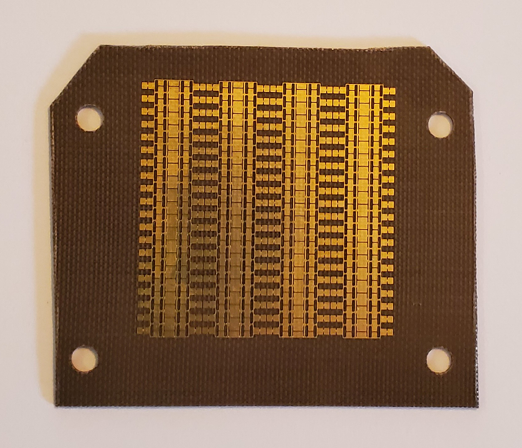
A multifocal metasurface lens for continuous wave doppler radar was designed for a 4×4 K band patch array antenna. The metaparticle structure used was a 2 layer dogbone structure for its simplicity and its proven control of the phase of an incident wave. This work was an exploration into the feasibility of developing an easily manufacturable and small profile metalens to enhance the gain of a patch array antenna.


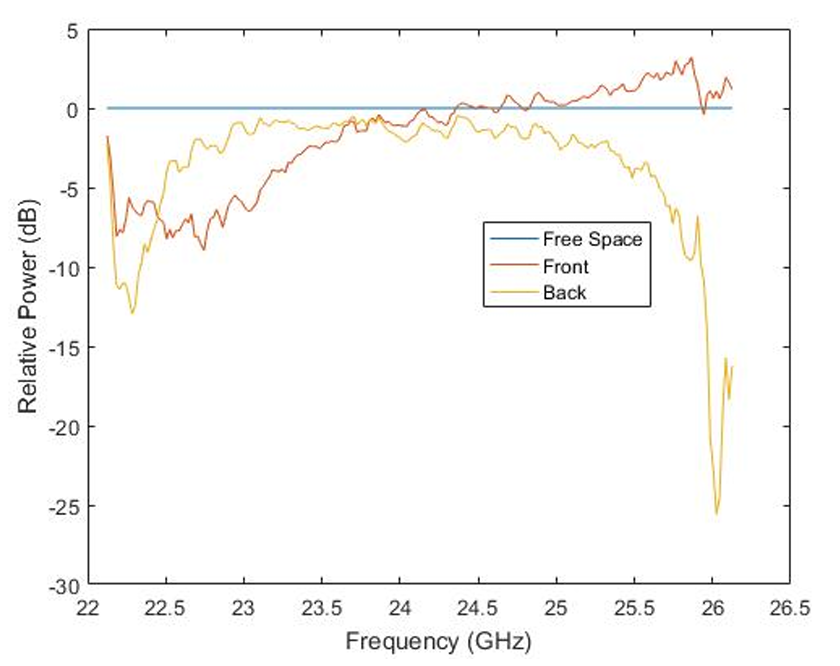
As seen above the results in orange of the metalens show a region of operation between 25.5 GHz and 26 GHz with a gain of about 2.5 dB. This is with the lens in normal operation. When reversed, the lens disperses the wave with a center frequency of 25.25 GHz.
As shown below, the chemically etched results have a much smoother gain pattern with a peak of about 3 dB. The reverse orientation exhibits a much sharper dispersion region due to the more consistent pattern and the fact that the mechanically etched lens has copper fragments within the substrate.

Additional investigations were done to determine the impact of the dogbone metaparticles oriented in one dimensional configurations. The results below show that neither is as effective or as stable as the 2D approach.
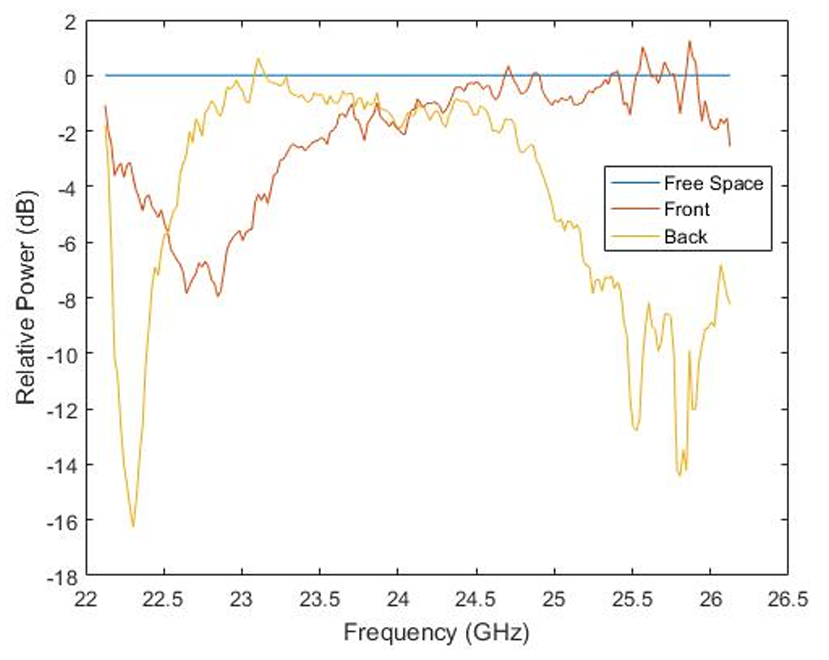

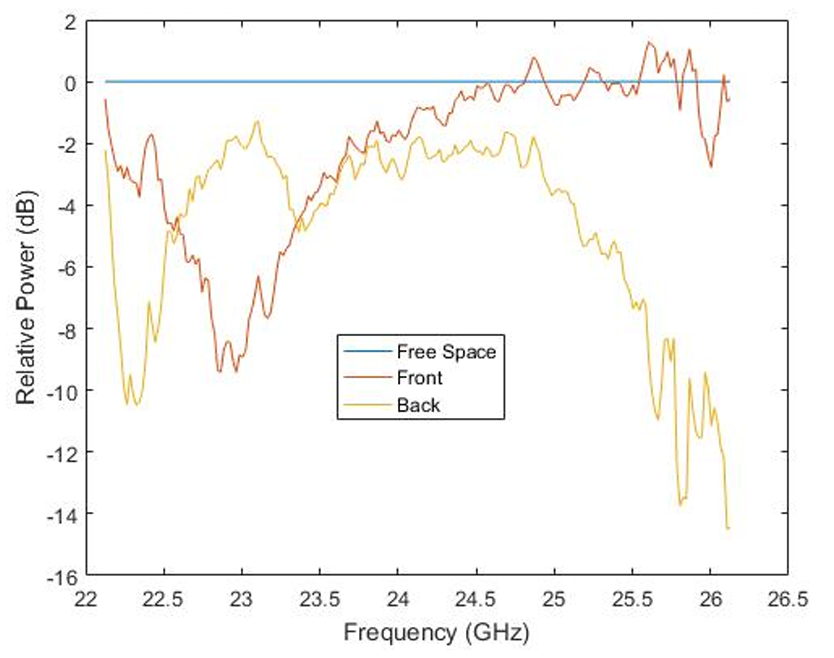
The difference in the gain pattern shows that a chemically etched lens performed better than a mechanically etched lens of the same pattern. A multilayer approach could prove more effective, however, manufacturing cost and variability would increase and an investigation into the results is needed. The 2-layer dogbone metaparticle has potential to be used in the application of a metalens with proven results.
 MHO SCIENCES